
Rules and Regulations
Find out what is expected of you at school, from uniform and grooming standards to rules on attendance, device use, and conduct.
SCHOOL RULES AND REGULATIONS
1. School Uniform
Students are to wear the prescribed school uniform, and no modification to the uniform is allowed.
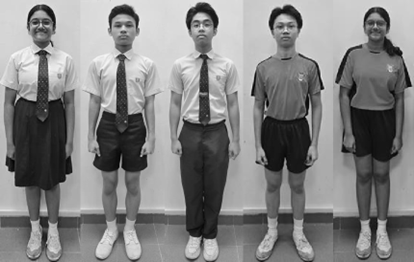
For female students
Dark blue skirts must touch or cover the knees.
Coloured undergarments are not allowed.
For male students
Dark blue shorts for Lower Sec students.
Dark blue long pants for Upper Sec students.
No tapering of long pants is allowed.
For male and female students
Short- sleeved white blouse (pointed collar) with pocket on the left.
The school badge must be sewn on the shirt pocket.
Shirts and blouses must be tucked into the pants/shorts/ skirts at all times.
Plain white ankle socks are to be worn.
Only white canvas/ white sports shoes are to be worn.
Jackets/windbreakers are not to be worn during assembly. Should it be used, (e.g. in air-conditioned rooms/medical grounds), only plain ones (e.g. black, blue, white) are allowed (without logo or markings).

2. Personal Grooming
Dyeing, tinting or highlighting of hair and tattoos are not allowed. In addition, all students must observe the following:
For female students

Long hair (below shoulder) should be plaited or tied back neatly with a black or dark blue ribbon. Only black or dark-blue hair bands and clips should be used where necessary.
Fringes should not touch the eyebrows. Long fringes must be pinned up.
For male students

All boys must wear a neat short hairstyle.
Males being clean shaven.
Fringes must end above the eyebrows.
Hair must not touch the collar and ears.

Sideburns and facial hair are not allowed.
Any outlandish hairstyles are not allowed.
*The school management reserves the right to reject any new hairstyle it deems inappropriate for school.
3. Other Aspects of Personal Grooming
The following are strictly prohibited:
Jewellery such as chains, necklaces, rings or bracelets (e.g. leather bangles, friendship bands and rainbow looms).
Coloured/big-eye contact lenses, cosmetics, foundation/ sunscreen (of different skin tone), long nails, fake nails, nail polish, coloured pimple patches/plasters, henna staining.
Ear-sticks/nose-studs/eye-lid studs/tongue studs. However, girls are permitted to wear a pair of plain ear-studs at the earlobes.
4. Pledge-taking and Singing of National Anthem
All students are to assemble at the Multi-purpose Hall/classroom with their respective classes by 7.25am from Mondays to Fridays. Students who are not in the hall/classroom by 7.30am are deemed to be late.
Students who are Singapore citizens must sing the National Anthem and take the Pledge with the right fist over the heart. Foreign students must stand at attention.
5. Attendance and Punctuality
Attendance in school is compulsory. Form Teachers will check and confirm the daily attendance of students before the flag-raising ceremony.
All students are required to attend school regularly and take responsibility for their own learning. Any absence from school must be supported by a valid Medical Certificate (MC) or a parent’s/guardian’s letter, which must be submitted to the Form Teacher on the first day the student returns to school or through Parents Gateway. Not more than five (5) parent's/guardian's letter are allowed per semester. Absence without any valid reason will be considered truant and may result in disciplinary action.
Students who need to leave the school premises during school hours must seek permission from the General Office. Parents/Guardians will be notified and to accompany the student home.
Students are not allowed to leave Singapore during term time unless supported by valid reasons and formally endorsed by the school.
All students must be punctual when reporting for class or any school activity. Students who do not have a valid reason for being late will face disciplinary action.
Attendance for Co-Curricular Activities (CCA) is compulsory. If a student is absent from school in the morning, his/her CCA attendance status will follow the morning attendance status. If a student needs to leave school before 5.30 pm on a CCA day, a valid reason must be provided.
Students are not allowed to leave classrooms during lessons without the teacher’s permission. A Student Movement Pass must be obtained and shown upon request by any teacher.
6. Classroom Conduct
All students must stand up and greet the teacher when he or she enters or leaves the classroom.
Students are not to rest their heads on the table during lessons and are expected to maintain an attentive and respectful learning posture at all times.
All school bags must be placed neatly on the floor beside the desk. Students are not to place bags on their laps or hug them during lessons.
All fans and lights must be switched off when leaving the classroom.
7. Use of Mobile Electronic Devices
All mobile/smart devices (e.g. phones, tablets, smart watches, etc.), other than school-approved laptops, must be kept in designated handphone lockers from the start of school hours (7.30 am) till the end of lesson hours (based on individual timetable) or end of CCAs (whichever is later). This would include all time-tabled periods such as recess.
Mobile/smart devices may only be retrieved from handphone lockers just before leaving school at the end of lessons or CCAs.
Unauthorised possession and use of mobile/smart devices may result in a referral to the school’s Disciplinary Committee for follow-up action and subsequent confiscation of the devices. Parents will be notified, and students are to report after school to complete a reflection before the devices are returned.
Security and safety of all electronic mobile/smart devices is the sole responsibility of the student, and the school is not accountable for any loss of such items.
8. Prohibition of possession of weapons/weapon-like items
All students are not allowed to have any weapons in their possessions. They are also not allowed to bring any weapon-like item which can be used or intended to be used to cause harm to others.
9. Possession and Use of Electronic Cigarettes (Vaping Devices)
All students are strictly prohibited from possessing, using, selling, or distributing any electronic cigarettes, vaporisers, or related components within or outside the school premises.
Students found in possession or use of such devices will face school-based disciplinary actions which may include in-school suspension, out-of-school suspension, caning, and an adjustment of conduct grade to “Fair” or “Poor” — in addition to any national penalties imposed by the Health Sciences Authority (HSA), Police and the Courts.
Students found selling or trafficking e-vaporisers will face enhanced school consequences, which may include expulsion.
10. School Rules on Search of Student Belongings
The school is committed to maintaining a safe and disciplined environment for all members of our school community.
As part of this commitment, the school may conduct searches of student belongings (e.g., bags, folders, files, uniform pockets, digital devices) where there is reasonable cause to believe an offence may have been committed or prohibited or dangerous items are present. Searches of student belongings may also be carried out on a random basis as a general safety measure, and to help maintain a safe and disciplined environment.
The school will confiscate items which are prohibited, dangerous, and/or suspected of containing evidence of an offence/crime. If such items are found, parents/guardians will be informed, and the items may also be turned over to the relevant authorities.
11. Offences and Consequences
Students who fail to comply with the School Rules and Regulations will be subject to disciplinary action.
A. Minor Offences
Minor Offences and Consequences
Minor Offences | Possible Consequences (Generic)/ |
Late coming |
|
Inappropriate attire/grooming | |
Modification of school uniform | |
Disruptive behaviour in class | |
Unauthorised use of devices |
B. Major Offences
Major Offences and Consequences
Major Offences | Possible Consequences (Generic) / Remarks |
Defiance and rudeness to school staff or student counsellors |
|
Use of vulgar/obscene/abusive/ threatening words | |
Skipping lessons | |
Leaving school without permission | |
Bullying/Cyberbullying | |
Truancy | |
Smoking/Vaping or possession of cigarettes (including e‑cigarettes), lighters and tobacco products | |
Cheating during tests/examinations | |
Fighting/Assault/Rioting/ Voluntarily Causing Hurt | |
Vandalism | |
Substance/Drug abuse | |
Other serious offences |
The school reserves the right to decide on the appropriate consequences that will lead to the best learning outcome for the student.
12. Conduct Grade
A student’s conduct grade is determined based on his/her overall conduct for the semester. The general descriptors are as follows.
Conduct Grade Table
Grade | Descriptors |
Excellent/ Very Good | The student consistently demonstrates strong personal discipline and school values. He/She maintains good attendance and punctuality, presents himself/herself appropriately, shows positive attitudes, respects others, participates actively in class and completes all assigned work diligently and responsibly. |
Good | The student generally displays appropriate conduct and positive attitudes. He/She attends school regularly, follows rules most of the time, shows respect to others and completes schoolwork with minimal reminders. |
Fair | The student shows inconsistent conduct and requires frequent reminders to meet expectations. There are observable lapses in attitude, behaviour or responsibility, and limited effort is shown to improve despite guidance. |
Poor | The student displays persistent conduct concerns and demonstrates disregard for school rules and expectations. Behaviour negatively impacts learning and relationships, with minimal effort made to improve despite repeated interventions. |
A student may be awarded a Fair or Poor conduct grade if there are significant concerns in areas such as low overall school attendance, poor CCA attendance (<75%), high frequency of late coming (>5), and/or involvement in a serious offence. The school reserves the right to award the final grade based on overall input.
13. Anti-Bullying Policy
Our Commitment
At Dunearn Secondary School we believe every student deserves to feel safe, valued, and supported in their learning journey. We are committed to creating a caring and enabling school environment where all students can flourish and develop positive relationships with their peers.
Our approach focuses on teaching kindness, empathy, and respect whilst addressing any hurtful behaviour that may arise. We work together as a school community – staff, students, and parents – to ensure everyone feels they belong.
What are hurtful behaviours and bullying?
Hurtful behaviours are unkind and hurtful acts such as once-off insensitive comments, actions and physical fights, while bullying involves persistent and intentional hurtful acts.
Hurtful behaviours and bullying can take various forms, including verbal, social, physical and cyber:
Verbal: Name-calling, spreading rumours, or making threats
Social : Deliberately leaving someone out, or encouraging others to ignore someone
Physical : Pushing, hitting, or damaging someone's belongings
Cyberbullying: Using technology like phones, computers, or social media to repeatedly hurt or embarrass others on purpose
The school’s firm stance against hurtful behaviours
The school adopts a zero tolerance policy against all forms of hurtful behaviour, ranging from insensitive one-off comments to persistent, intentional acts of bullying and physical violence. This policy guides how we identify, address and precent such behaviours across our school community.
We recognise that students may have disagreements or say things they do not mean. As such, we help students understand the difference between such conflicts, which are a normal part of growing up, and persistent bullying behaviour, ensuring that each situation is addressed with care and appropriate support.
How We Prevent Incidents
Take a firm and consistent stance against all forms of hurtful behaviours and bullying
Foster a caring and enabling school environment, with positive teacher-student relationships and strong peer support structure with trained student leaders
Conduct Character & Citizenship Education lessons on empathy, conflict management, resilience and cyber wellness
Maintain regular communications with students, staff and parents
How to Report Concerns
We want parents and students to feel comfortable coming to us with any concerns. You can reach out to us in several ways:
Speak directly to any staff member
Use our online confidential reporting form
Contact your child’s Form Teacher or School Leaders directly
How We Respond
Immediate physical and psychological safety measures for all students involved
Prompt investigation and timely updates, subject to case complexity
Consequences, including disciplinary actions, conduct grade adjustments, learning prosocial skills and reconciliation of relationships
Support plans for affected students, including victims and offender
Restorative support including school counselling, external referrals and community resources
Partnership with parents throughout the process, including informing parents at the earliest opportunity
When a concern is raised, we act promptly and with care:
Ensure the immediate safety and well-being of all students involved
Conduct a thorough investigation and provide timely updates, subject to case complexity
Apply appropriate consequences, which may include disciplinary actions, conduct grade adjustments and learning of prosocial skills
Put in place support plans for all affected students, including victims and those responsible
Provide restorative support through school counselling, external referrals and community resources where needed
Partner with parents throughout the process, keeping them informed at the earliest opportunity
How Parents Can Support
Talk regularly with your child about school experiences and friendships
Teach respectful behaviour and reinforce healthy digital habits at home
Monitor your child’s online and offline interactions and activities
Share concerns promptly with your child’s Form Teacher or Year Head
Work collaboratively with school on agreed interventions
Model positive behaviour in your own interactions, such as being calm and respectful in communications
Use 'teachable moments' in your daily interactions with your child to explain why certain conduct is inappropriate
Get in Touch
We are here to listen and help. If you would like to bring an incident to our attention, you can reach out to us via any of the following methods:
Inform Form Teacher, Discipline Master, Year Head or School Leaders
Call: 65653692
Email: dunearn_ss@moe.edu.sg
[Non-urgent cases only] Online reporting form: https://go.gov.sg/dssreportingform (opens in new tab)
For online harm (cyberbullying, harassment, etc), victims or parents can report directly at the platform -> https://report.osc.gov.sg/ (opens in new tab)
We review this policy regularly to make sure it continues to serve our school community well. Together, as a school community, we shape our students’ character, strengthen relationships, and build caring communities.